Autopapyrus · Hyundai Solaris (Accent) 1.6 G4FC (2013)
https://autopapyrus.com/guides/hyundai/solaris/diagnosing-a-suspension-knock/
https://autopapyrus.com/guides/hyundai/solaris/diagnosing-a-suspension-knock/
Compiled automatically from service literature and owner experience. Specs are for the typical configuration — check them against your exact car before you start.
Hyundai Solaris (Accent) 1.6 G4FC (2013): Diagnosing a Suspension Knock
A suspension knock on the first-generation Solaris (2010-2017) most often comes from the front: worn sway bar links, ball joints, or play in the control arm mounts. On a car of this age (2013), this is normal wear. Diagnosis requires an inspection over a pit or on a lift and a check for play in the components.
Parts
5| № | Part | Genuine part no. |
|---|---|---|
| 01 | Sway bar linksif worn | |
| 02 | Lower control arm ball jointsif worn | |
| 03 | Strut mount bearingsif worn | 54612-3S000 |
| 04 | Control arm bushingsif worn | 55274-A6000 |
| 55275-A6000 | ||
| 55215-A6100 | ||
| 05 | Shock absorbersif worn | 55300-A6500 |
| 55300-A6410 | ||
| 55300-A6700 |
Part numbers are from the manufacturer's original catalogue. Check them against your VIN before ordering.
Tools
4- Inspection pit or lift
- pry bar
- flashlight
- 12/14/17/19 mm wrenches
Step by step
7 steps- Drive the car onto a pit or lift and raise the front wheels so the suspension hangs fully extended (fully unloaded).
- Inspect the lower control arm ball joint boots (at the front, underneath, on each side) for tears, dirt, or leaked grease. A torn boot means play in the ball joint is imminent.
- Check the ball joint for play: place a pry bar between the lower control arm and the steering knuckle and slowly pry up and down. More than 2-3 mm of play means the ball joint is worn out.
- Check the sway bar link (the thin rod connecting the sway bar to the lower control arm): move it by hand in different directions. A knock means the bushing is worn or the joint has fallen apart.
- Check the lower control arm bushings (where the arm mounts to the subframe): press lightly on the arm with a pry bar. It should feel springy, with no hard knocking.
- Lower the car and bounce the body by hand at each corner. It should rebound firmly, without repeated oscillations (a sign of a worn-out shock absorber).
- On the road (in a safe place), drive slowly over a wavy surface or a speed bump and listen for where the knock comes from and under what conditions (only on compression, only on rebound, or always). Locating the knock: — A knock heard under the driver's pedals or at the front over bumps = front suspension, lower control arms, ball joints. — A knock heard from the side when entering a turn = sway bar link or outer ball joint (in a turn the body rolls and loads the outer side). — A knock heard at the rear, under the rear seats = rear suspension (the Solaris 1 has a semi-independent torsion beam, with frequent problems with mounts and shock absorbers). — A sharp, clearly localized metallic knock = usually a ball joint or a sway bar link bushing. — A dull, muffled knock = a control arm bushing or a shock absorber.
Common mistakes and warnings
- Do not ignore play in the suspension
- It affects handling and progresses quickly
- If you replace a ball joint or sway bar link yourself, use a puller (universal, M16-M20)
- Knocking it out with a pry bar is risky and can damage the arm
- Noisy rear shock absorbers are fairly common on the Solaris 1, so if the knock is at the rear, first check their rebound from the wheel well
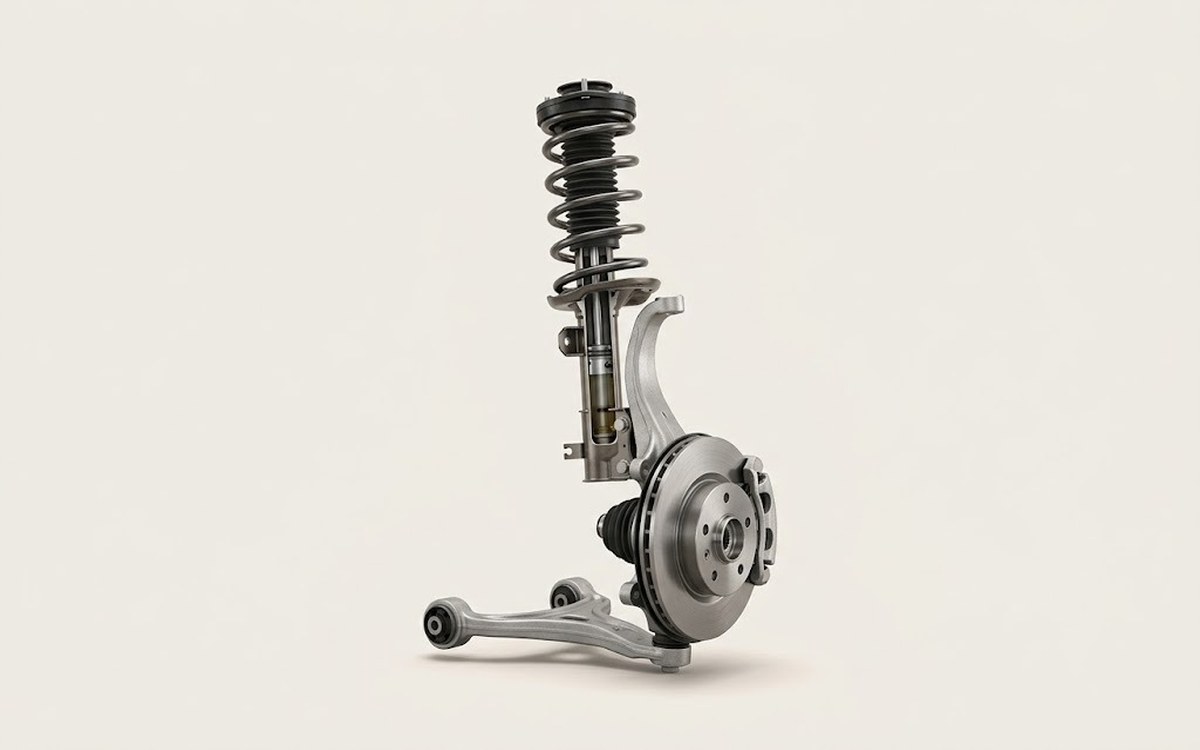 How it works · 3D
How Car Suspension Works
How the part you're working on actually works — in plain English, on a 3D model.
Open in 3D →