Autopapyrus · IM Motors LS7
https://autopapyrus.com/guides/im-motors/ls7/diagnosing-a-rear-suspension-knock/
https://autopapyrus.com/guides/im-motors/ls7/diagnosing-a-rear-suspension-knock/
Compiled automatically from service literature and owner experience. Specs are for the typical configuration — check them against your exact car before you start.
IM Motors LS7: Diagnosing a Rear Suspension Knock
The IM LS7 is equipped with a Continental adaptive air suspension and Bilstein electronically controlled shock absorbers. A knock from the rear can come from the air springs, shock absorbers, suspension arms, or mounting hardware. Diagnosis starts with a visual inspection on a lift and a check of the air system pressure.
Parts
6| № | Part |
|---|---|
| 01 | Continental air springsif faulty |
| 02 | Bilstein DampTronic adaptive shock absorbersif faulty |
| 03 | Control arm bushingsif faulty |
| 04 | Ball jointsif faulty |
| 05 | Sway bar linksif faulty |
| 06 | Suspension mountsif faulty |
Tools
5- lift or inspection pit
- pry bar
- flashlight
- wrench set
- multimeter (for checking air suspension sensors)
Step by step
10 steps- Raise the vehicle on a lift or position it over an inspection pit, and make sure you have access to the rear suspension.
- Inspect the air springs for cracks, abrasions, and air leaks. If an air spring is damaged, it loses pressure, the shock absorber works without support, and a knock occurs over bumps.
- Check the Bilstein shock absorber mounts, both the upper mount to the body and the lower mount to the control arm. Loose bolts or worn bushings produce a characteristic metallic knock.
- Check the bushings of the trailing and lateral rear suspension arms. Use a pry bar to move the arms. There should be no play. Worn bushings cause a dull knock over bumps and during acceleration and braking.
- Inspect the sway bar links. Move each one by hand. Play indicates worn bushings or deteriorated rubber elements.
- Check the tightness of the bolts that secure the suspension components to the subframe and body. Partially loosened bolts or increased gaps at the mounting points cause a knock.
- Turn the ignition on and activate the body raise/lower function through the infotainment system, and listen to the air suspension compressor. Excessive noise, prolonged running, or clicking indicates a leak in the system or a faulty compressor.
- Inspect the rear exhaust system. Make sure the muffler and resonator do not touch the body or suspension parts, especially when you rock the vehicle.
- Check the rear brake calipers. Worn guide pins or uneven pad wear can cause a knock during braking and over bumps.
- Bounce the body by hand at each corner. The shock absorbers should damp the motion within 1-2 cycles. If the body keeps bouncing or you hear knocks, the shock absorbers are worn or the DampTronic system is faulty.
Common mistakes and warnings
- The IM LS7 is a high-voltage electric vehicle
- When working under the vehicle, be careful around high-voltage cables (orange insulation)
- Do not work on the high-voltage circuit without special training and 1000 V insulated gloves
- The Continental adaptive air suspension and the Bilstein DampTronic system are complex, electronically controlled assemblies
- If your diagnosis points to a fault in the electronic components (level sensors, air suspension control unit, shock absorber solenoid valves), take the vehicle to an authorized IM Motors service center for diagnosis with factory equipment
- You can replace the air springs and shock absorbers yourself if you have suspension experience, but calibrating the system after replacement requires dealer software
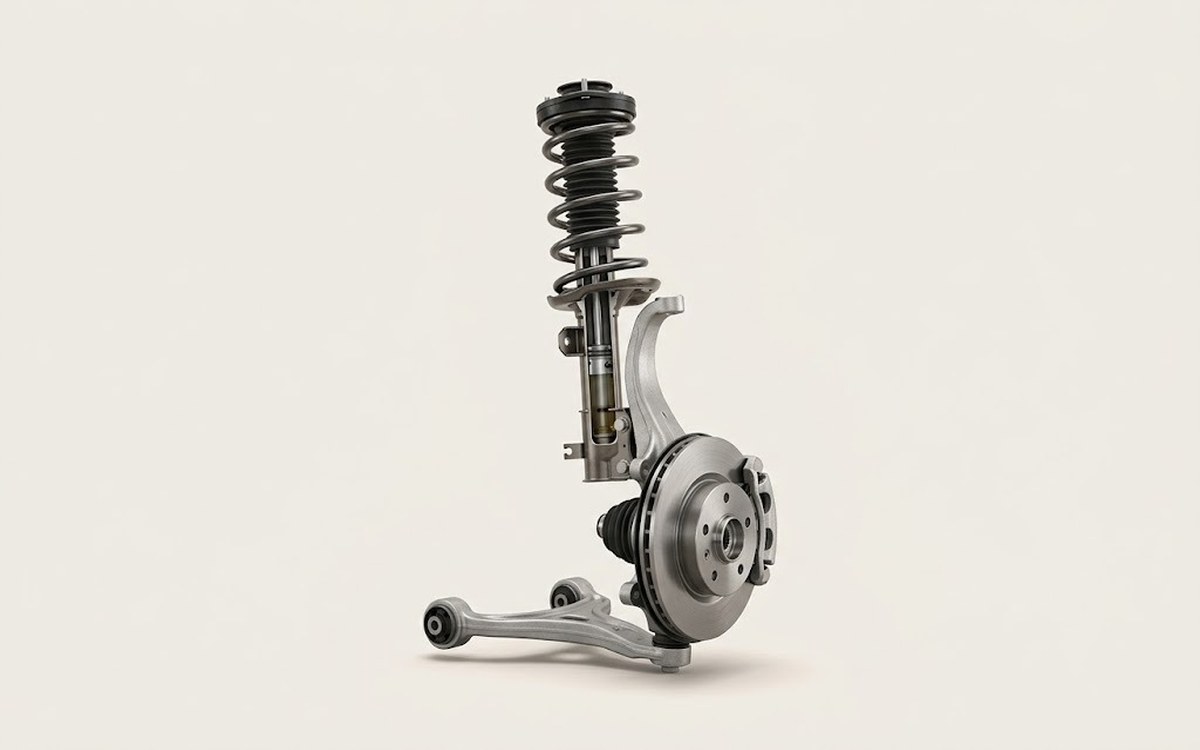 How it works · 3D
How Car Suspension Works
How the part you're working on actually works — in plain English, on a 3D model.
Open in 3D →